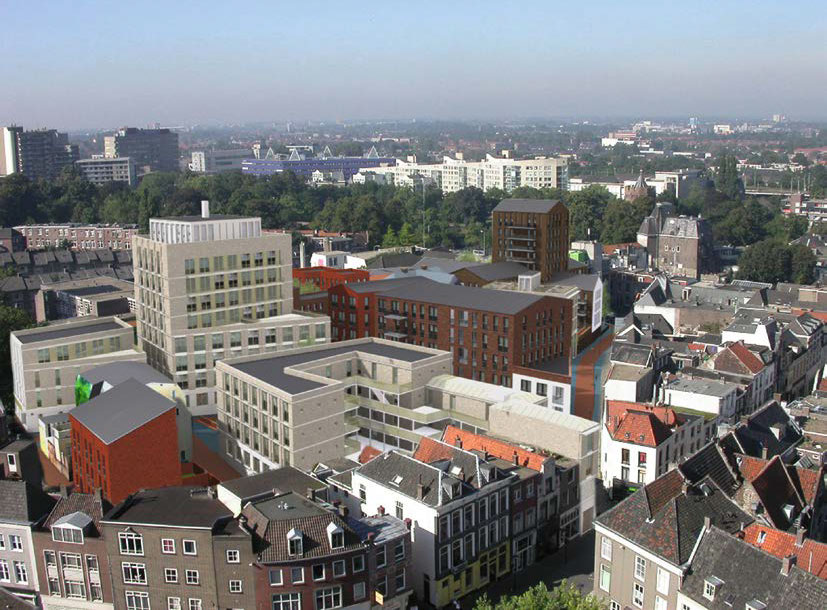
Rediscovery of a housing type
Downloads
DOI:
https://doi.org/10.47982/overholland.2025.23.260Abstract
This article re-examines the palazzo as a residential building type and argues for its renewed relevance in contemporary housing design and architectural education. Rather than approaching the palazzo as a historical or stylistic artefact of the Italian Renaissance, the author frames it as a typological principle rooted in spatial organisation, repetition and urban context. Central to this redefinition is the palazzo’s centripetal structure: a multi-storey urban building organised around a courtyard that functions simultaneously as circulation space and architectural core.
Drawing on historical examples from Florence, Genoa, Naples and Venice, as well as on theoretical reflections by figures such as Berlage, Quatremère de Quincy and Martí Arís, the article clarifies the distinction between the palazzo and superficially similar building forms such as the almshouse courtyard or the closed urban block. A typological matrix is introduced to demonstrate how the stacking and repetition of standardised dwelling units around a courtyard generate consistent yet image-free ordering principles. This matrix serves primarily as a didactic tool, enabling students and designers to engage with type as an abstract, generative framework rather than a stylistic model.
The article further situates the contemporary rediscovery of the palazzo within a broader architectural shift towards craftsmanship, tectonics and the “ordinary,” following criticism of late-modern formalism and spectacle architecture. Through examples from design practice and international teaching studios, the palazzo is shown to offer an alternative to normative housing models by integrating density, spatial hierarchy and urban presence.
The author concludes that the palazzo’s enduring value lies in its capacity to reconnect housing design with disciplinary knowledge, professional authority and the city as its primary context, making it a productive reference for addressing today’s housing challenges.
How to Cite
Published
Issue
Section
License
Copyright (c) 2026 Hans van der Heijden

This work is licensed under a Creative Commons Attribution 4.0 International License.