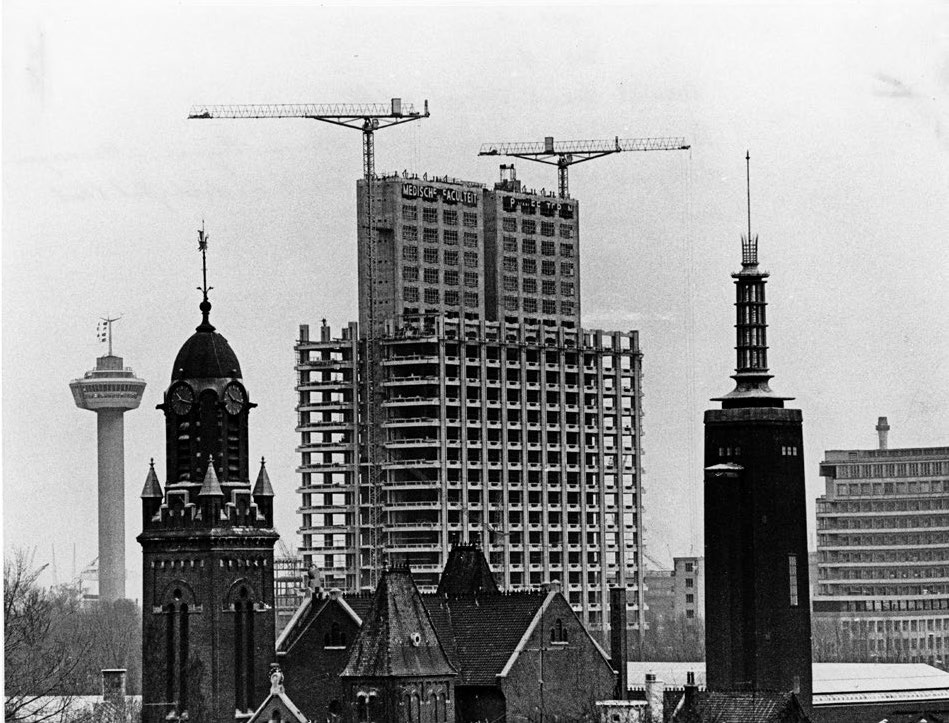
Rotterdam inner city in detail

The emergence of high-rise buildings in five maps (1940–2030)

Authors

  • Iris van der Wal
  • Esther Gramsbergen
  • Yağız Söylev
  • Elif Soylu

Downloads

DOI:

https://doi.org/10.7480/overholland.2025.23.259

Abstract

This article analyses the emergence of Rotterdam as the Netherlands’ foremost high-rise city by examining the development of high-rise buildings in the city centre between 1940 and 2030. Using an atlas-based methodology, the authors present five map series corresponding to distinct periods of urban transformation: 1940–1970, 1970–1985, 1985–2000, 2000–2015 and 2015–2030. Buildings taller than 70 metres—the municipal definition of high-rise—are visualised in three dimensions, allowing shifts in spatial distribution, function and scale to be studied over time.

The atlas combines cartographic analysis with policy documents, planning debates and key architectural projects to trace how ideas about high-rise buildings have evolved. In the post-war reconstruction period, high-rise buildings were embedded in modernist ideas of city formation and functional separation, often resulting in monofunctional environments and negative perceptions of living at height. From the 1970s onward, criticism of these modernist principles led to a temporary slowdown in high-rise development and a renewed focus on urban livability.

From the mid-1980s, high-rise buildings re-emerged as instruments for economic revitalisation, densification and city marketing. Office towers initially dominated, followed by a strong shift towards residential high-rise after 2000, as the municipality sought to reintroduce housing and urban life into the city centre. Throughout the article, attention is paid not only to what was built, but also to who shaped the discourse—municipal authorities, architects, developers and critics—and how power relations influenced outcomes.

The article concludes by situating the current temporary high-rise moratorium (2023–2026) as a moment of reflection, highlighting ongoing tensions between skyline ambitions, housing demand and the quality of the urban living environment.

How to Cite

Iris van der Wal, Esther Gramsbergen, Yağız Söylev, & Elif Soylu. (2026). Rotterdam inner city in detail: The emergence of high-rise buildings in five maps (1940–2030). OverHolland, 15(23). https://doi.org/10.7480/overholland.2025.23.259

Published

2026-01-07

Author Biographies

Iris van der Wal

Iris van der Wal (1992) graduated on redesigning contested heritage at TU Delft’s Faculty of Architecture. As an architect and researcher, she creates ways for people to engage with knowledge and stories about architecture, history and sustainability through various collaborative projects: from
publications and teaching to experimental exhibition designs and architectural interventions. Currently, she is working on projects concerning post-1965 architecture and urbanism in Rotterdam and exploring bottom-up circular demolition practices in Japan. She has taught at the Design Academy Eindhoven and at TU Delft, where she also led the university’s art, science, and technology programme ‘Crossing Parallels’ and is involved in research projects.

Esther Gramsbergen

Esther Gramsbergen (1964) graduated in architecture from TU Delft’s Faculty of Architecture in 1989. She has worked for various architectural firms, including Karelse van der Meer Architects and the ArchitectenCie. She is an assistant professor in architectural design at TU Delft’s Faculty of Architecture since 1999 and editor of OverHolland since 2009. In 2014, she obtained her PhD at Delft on the dissertation Kwartiermakers in Amsterdam. Ruimtelijke transformatie onder invloed van stedelijke instellingen, 1580-1880 [Quartermasters in Amsterdam. Spatial transformation under the influence of urban institutions, 1580-1880], a trade edition of which was published by Vantilt publishers. Continuing along this line, her current research focuses on the role of urban institutions, such as universities, in more recent transformations of Dutch cities. In 2020, she initiated with Ayşen Savaş and Yağız Söylev the Campus Utopias programme.

Yağız Söylev

Yağız Söylev (1991) is an architect, researcher, and PhD candidate at the Department of Architecture, TU Delft. He obtained his master’s degree in architecture cum laude at TU Delft (2018). At the Biennale di Venezia that same year, he served as associate curator of the Pavilion of Turkey. His work has been exhibited in venues such as the Istanbul Design Biennale. Since 2019, he has been teaching at TU Delft’s Faculty of Architecture, where he leads multiple MSc design studios and contributes to the department’s research and education. He has also taught as guest lecturer at Università Iuav di Venezia and the Academie van Bouwkunst Amsterdam. Since 2021, he has been co-responsible for the
cartographic studies in OverHolland.

Elif Soylu

Elif Soylu (1995) is an urbanist and researcher based in Rotterdam. She holds bachelor’s degrees in Architecture and Interior Design from Istanbul Bilgi University and an MSc in Urban Design from TU Berlin. Her research explores urban transformations shaped by water infrastructures, production landscapes, and energy systems, combining oral histories, mappings, archival research, and storytelling. She has contributed to international exhibitions such as BOZAR (2019), the International Architecture Biennale Rotterdam (2020), and the Venice Architecture Biennale (2021), as well as to
the British Academy–funded project Futures of Listening, focusing on water knowledge in Jakarta and Istanbul. Her thesis, Cartographies of Flow: Entangled Stories of Istanbul’s Waters, examined the socio-spatial transformations of Istanbul’s water infrastructures. She was editorial assistant of Power, Flows,
and Transformation: Portraits of Berlin-Brandenburg Energy Spaces and is currently a fellow of the European Architectural History Network (EAHN).